Vea’s Party Incident
The DispossessedVea’s Party Incident turns Shevek’s public condemnation of possessive society into a personal ethical crisis. At a party on Urras, he contrasts the abundance enjoyed by its owners with Anarres’s scarcity and praises the human freedom he associates with possessing nothing. Yet when Vea’s flirtation becomes a refusal, he initially fails to recognize its force. He ultimately stops, but the encounter exposes a gulf between his ideals and his conduct, and ends with him fleeing the party in distress.
The Anarres–Urras Contrast
The incident follows Shevek’s account of the worlds that have shaped his judgment. His description of Anarres is unsparing: dusty hills, small and dreary towns, hard work, and shortages mean that people cannot always obtain what they want or need. By contrast, he lists Urras’s ample air, rain, grass, oceans, food, music, buildings, factories, machines, books, clothes, and history. The contrast is not simply between deprivation and comfort; it is between a society that lacks material abundance and one in which abundance is owned.
Shevek turns that contrast into a moral argument. He says that Anarres has little beauty beyond the faces of its people, while Urras displays jewels and other possessions. The eyes he sees on Anarres signify, for him, the splendor of people who are free because they possess nothing. Urrasti owners, by contrast, are themselves possessed: isolated with what they own, they live within a prison whose enclosing image is a wall. This language gives the party scene its central tension. Shevek can diagnose possession as a form of confinement, but the encounter that follows tests whether he can treat another person as free rather than as an object of his assumptions.
Flirtation and Refusal
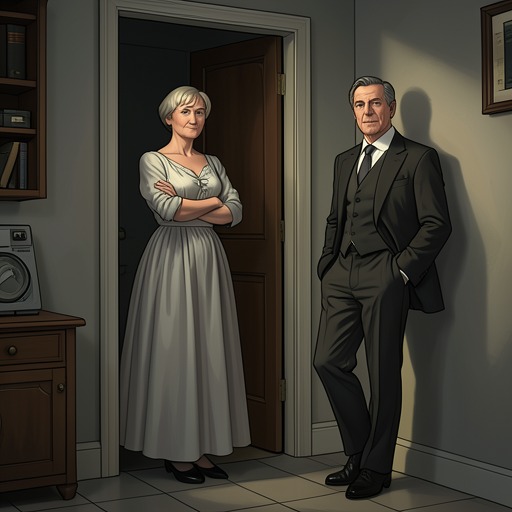
Vea approaches Shevek after his speech, calls him magnificent, and says she wants to kiss him. He responds by kissing her and trying to take their encounter further. At first, she yields and continues speaking, but she then repeatedly tells him to stop and explains that she has not taken contraception and must be careful because her husband is due back in two weeks. She also asks him not to damage her clothes and proposes that they arrange to meet elsewhere.
Shevek does not respond to those objections as a refusal. He continues despite Vea’s requests, until her tone and struggle make her fear unmistakable. She pushes against him and tells him to let her go; he then releases her. The sequence matters because Vea’s initial flirtation and willingness to kiss do not amount to continuing consent. Her changing response is made explicit, and Shevek’s persistence after she asks him to stop constitutes a serious breach of her expressed boundary.
Aftermath and Significance
Once Vea is free, Shevek stands dazed and struggles to apologize, saying that he thought she had wanted the encounter. He then turns and leaves the dim room. His explanation registers his misreading, but does not undo the refusal he ignored. The scene presents the distance between his belief in freedom and his treatment of Vea as more than an abstract contradiction: another person’s stated wishes are the immediate test of that belief.
Back in the bright party room, Shevek stumbles through the crowded space, where bodies, clothing, jewels, furniture, and food obstruct his way. He reaches a table bearing a silver platter of tiny pastries arranged in concentric circles and vomits over it. The abrupt physical consequence ends the episode without resolving its ethical conflict. The contrast between the dark room and the bright party, and between Shevek’s earlier image of the wall and his disordered retreat, makes the incident a collapse of his public certainty into personal confusion. His denunciation of a society in which people are possessed cannot stand apart from the obligation to recognize another person’s independence.